One of the things my husband and I have been looking forward to when we move up to the farmhouse is having a small flock of chickens for our own use. We may also sell some eggs to friends and family, but this isn't intended as a money-making venture so much as a cost-reducing venture. Also, I have to admit I prefer the taste of a really fresh egg, and I like knowing what went into my food - these are all reasons that I'd like to farm, in general, so a small flock makes sense and helps diversify our "portfolio".
A note here - I firmly believe, after all my research, that the ability to diversify and add value is what will make this farm work. Too many farms in this neck of the woods are dairy, period, and so they're all tied to the ever-falling profit from dairy, and they can't easily regear. I plan to sell cashmere, wool, possibly angora (both handspun and ready-to-spin), but I also plan to sell breeding stock and freezer meat. A few highland cattle will help protect my smaller animals, cut down on parasites in the pasture, yield some tasty and potentially valuable beef, and possibly even give me an unusual yarn to market. I'm hoping to have linen to sell, which should make me stand out more in the market, but if I'm trying hops and brooms this year as well to see what production would look like there. Once I'm up at the farm I'm planning on adding two beehives to see about small-scale honey production, but the threat of bears means I'm waiting until the place reeks of humans. I also fondly remember raising geese as a child, and as an adult have realized they command an impressive per unit price - based largely on rarity and tastiness. Altogether, this somewhat schizophrenic homestead should be light on its feet and able to navigate constantly-changing economic paradigms without too much damage. Or, at least that's the plan.
At any rate, the chickens-
Between my husband and I, we seem to have settled on three breeds that catch our fancy: Wyandottes, Marans, and Welsumers.
Wyandottes are the all-purpose chicken of 1880s New York - really, quite appropriate to our historic farmstead! They're cold-hardy; generally considered winter layers; good layers of larger, tinted eggs; good meat birds; broody hens are excellent mothers; not particularly aggressive. They come in a number of attractive colorations, and have a beautifully proportional look to them - curvy and balanced.
Marans are a early 20th century French breed, very "au courant" at the moment, and known far and wide for their dark "chocolate-colored" eggs. They come in a couple colorations - I like Black Copper. They should be moderately hardy, respectable layers of large, dark eggs; but by all accounts they've suffered somewhat from their popularity, and the selection for hardiness, productivity, egg color/size, etc., have fallen off in favor of producing more birds faster. Hatchery Marans in particular seem to be suspect, with some owners talking about having hens that are indistinguishable from, say, a Barred Rock. They seem a bit risky to me, and very... fashionable, in a bad way (for instance, Martha Stewart has Marans), but the eggs do have a definite wow-factor and I'm willing to give them a shot. My husband's already decided the putative Marans rooster will be "Cadbury", and I can't argue with that. ;)
Welsumers (or Welsummers - I'm still not sure which spelling is "right") are a 20th century dual-purpose Dutch breed that lays large, dark brown eggs (not quite as dark as Marans eggs, but close!). Being dual-purpose, they're also good tasty meat chickens. They're quite hardy, but not winter layers like the Wyandottes. In general they're supposed to be reasonably docile but able to fend for themselves. They seem to only come in one color - known to chicken people as Red Partridge - but I find it appealing.
(Henderson's Chicken Chart has pretty much everything you might want to know about the not-bizarrely-rare breeds of chickens in a convenient comparative format. Bookmark it - it's nearly perfect.)
One of the difficulties, though, is where to get these future chickens from... They're not your run-of-the mill hatchery sex-link hybrids, or your standard egg productions breeds, or (heaven forbid!) the ubiquitous Cornish Cross that is so ill-suited to a homestead-type operation. I could maybe get them from breeders, but the thought of $7-9/chick, with a minimum order of 12 or 15 chicks, and $30 shipping on top of that (so, $120-$160 for 12-15 chicks, assuming I can get all three breeds from the same breeder... yow. Plus, they're sold straight run, so no assurances on sex ratios.) I could try and buy started pairs, but they're harder to come by and not cheap, either (I just saw a started pair of Black Copper Marans go for $80 at auction). Hatcheries are easy to come by and order from, but generally have a 25 chick minimum order, and are apparently kind of unreliable with the "specialty" breeds. Sand Hill Preservation Center gets some pretty good reviews from chicken people, and seems to be in it for the preservation of the breeds - there are maximum orders on the chickens, as well as minimums. There's a 25-chick minimum, and the breeds I want are $4 or $5, shipping is $35.... so $143 for 25 chicks?
This article suggest the way to house chickens is in deep litter on an earthen floor, which appeals to me greatly. I think they make some fantastic points - very convincing! (You should also read their article on bringing back the broody. Awesome.) The most salient point is, for the deep litter to work I'm going to need 5 sqft/chicken. If I'm ordering 25 chickens, straight run, I need to plan on 13 cockerels (possibly more, possibly less, but a reasonable estimate). I'll probably want to keep one rooster per breed, so that means I need to plan on putting 10 cockerels in the freezer and housing 15 adult chickens (requiring 75 sqft). It would be prudent to design a coop that allows for expansion - if I make the coop 1/3 bigger, it would be 100sqft (conveniently 10ft*10ft), and hold up to 20 chickens.
Obviously, if I do the deep litter/earthen floor idea, I can't do one of my favorite coop plans, the miniature gypsy caravan. But I think I can still do a charming and functional coop, perhaps one more in line with the rest of the farm buildings.
Expect plans here in the coming months.
Sunday, April 10, 2011


Monday, March 21, 2011
Nondescript.
Not much going on around here this week. I'm still knitting the afghan and painting the tiles. I didn't get to spin my yak (what an odd turn of phrase that is!) at all this week. I did manage to get some of my seeds started - tomatoes and the like - so that's something. Other than that, a quiet week with not a lot to show for it.
Monday, March 14, 2011
Making pictures
I have been busy lately, though perhaps not terribly productive. The beginning farmer class is taking up actually a fair bit of my time; and there's always the 9-to-5 job, as well. It's been hard to do anything that feels like concrete progress toward the farm. Maybe it's the late-winter blahs (and our recent snowstorms) talking, but it feels like everything for the farmhouse is too big, too expensive, too up-in-the-air for me to actually do anything about right now, I can feel the inertia and helplessness setting in.
Well. We can't have that.
Obviously the cure for this is pick something - anything - preferably easy and smallish and fun, and just do it. I chose a kitchen work table that needs making for the farmhouse. I've looked for one that would fit my needs, taste, and budget, but there doesn't seem to be such a thing out there. It actually will be cheaper and easier to make it this time, even with my hackneyed carpentry skills! I decided I wanted delft-style tiles to top my table, and that I'd need about 90 4" tiles (it will actually probably be less than this, because of grout line spacing, I guess?). You can get decent reproduction delft-style tiles for around $12/tile, or so the internet claims, which puts my tabletop at ..... $1080. Yeah, I don't think so.
I bought a box of 100 plain white field tiles at Lowe's for $16 (they also sell them individually for $0.16, but the box of 100 is more convenient than 90 loose tiles, and gives me 10 spare to play with), and a pot of Porcelaine 150 ceramic paint in Lapis from Michael's for about $5. I also splurged and got a new set of paintbrushes to go with it (another $9). So, for $30, I'm set for tiles for my tabletop - maybe $35 if I need a second pot of Porcelaine 150. Does that mean I saved $1050??
Painting these has been incredibly fun and relaxing, for the most part. Mostly they're turning out beautifully, though I freely admit the dog looks more than a little cartoony (the cat too, come to think of it). Even the questionable ones, though, work in the greater scheme of blue-and-white order. I love it.
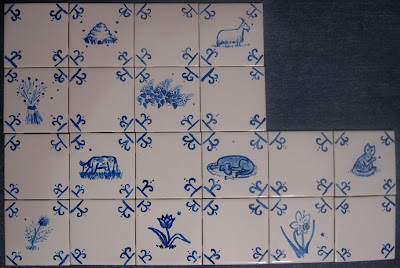
I'm about 1/5 of the way through. In theory, when I'm done I'll have 5 spare "picture" tiles and 5 spare "just corners" tiles, so I'll be able to pick and choose a bit if some motifs are outstandingly bad. I could also always turn a "just corners" into a "picture" if I had to, so that expands my do-over factor. I'm not too worried, though, because they're beautiful.
In tangentially-related news, I've been working on my "Epic" afghan again! Those of you who know me on ravelry.com (as "melanogaster") have seen this before, but it's a massive, double-knit, masterwork of an afghan. I worked out the chart myself, based on Schon Neues Modelbuch.
Currently I'm on row 28 of... 348, not counting the 2-row setup and finish (i.e., I'm on the row [column, in the chart] just to the right of the green line) . But I'm absurdly proud of the silly thing, and I'd be happy to pass the charts on to anybody who wanted them, as long as I got credit - I'll probably make it available on ravelry once mine is done. There will be pics in maybe 10 - 15 more rows, when it looks more obvious to other people. To me it looks fantastic, though.
Well. We can't have that.
Obviously the cure for this is pick something - anything - preferably easy and smallish and fun, and just do it. I chose a kitchen work table that needs making for the farmhouse. I've looked for one that would fit my needs, taste, and budget, but there doesn't seem to be such a thing out there. It actually will be cheaper and easier to make it this time, even with my hackneyed carpentry skills! I decided I wanted delft-style tiles to top my table, and that I'd need about 90 4" tiles (it will actually probably be less than this, because of grout line spacing, I guess?). You can get decent reproduction delft-style tiles for around $12/tile, or so the internet claims, which puts my tabletop at ..... $1080. Yeah, I don't think so.
I bought a box of 100 plain white field tiles at Lowe's for $16 (they also sell them individually for $0.16, but the box of 100 is more convenient than 90 loose tiles, and gives me 10 spare to play with), and a pot of Porcelaine 150 ceramic paint in Lapis from Michael's for about $5. I also splurged and got a new set of paintbrushes to go with it (another $9). So, for $30, I'm set for tiles for my tabletop - maybe $35 if I need a second pot of Porcelaine 150. Does that mean I saved $1050??
Painting these has been incredibly fun and relaxing, for the most part. Mostly they're turning out beautifully, though I freely admit the dog looks more than a little cartoony (the cat too, come to think of it). Even the questionable ones, though, work in the greater scheme of blue-and-white order. I love it.

I'm about 1/5 of the way through. In theory, when I'm done I'll have 5 spare "picture" tiles and 5 spare "just corners" tiles, so I'll be able to pick and choose a bit if some motifs are outstandingly bad. I could also always turn a "just corners" into a "picture" if I had to, so that expands my do-over factor. I'm not too worried, though, because they're beautiful.
In tangentially-related news, I've been working on my "Epic" afghan again! Those of you who know me on ravelry.com (as "melanogaster") have seen this before, but it's a massive, double-knit, masterwork of an afghan. I worked out the chart myself, based on Schon Neues Modelbuch.
 |
| A portion of the chart, turned 90 degrees from what you'd usually expect. |
Currently I'm on row 28 of... 348, not counting the 2-row setup and finish (i.e., I'm on the row [column, in the chart] just to the right of the green line) . But I'm absurdly proud of the silly thing, and I'd be happy to pass the charts on to anybody who wanted them, as long as I got credit - I'll probably make it available on ravelry once mine is done. There will be pics in maybe 10 - 15 more rows, when it looks more obvious to other people. To me it looks fantastic, though.
Sunday, February 27, 2011
Pre-ordered hops
Inspired, largely, by this manual *, and by my co-workers' continuing homebrewing successes, I've pre-ordered 6 rhizomes of "cascade" hops. My plan is to include small-scale hop production on the farm, producing more-or-less specifically for my coworkers' brewing needs. I'm convinced it will fit smoothly with the planned farm operations, adding another diversified income source. If production ultimately exceeds my coworkers' demand - which I expect will take several years - I hope to take my excess to local homebrew suppliers. I'm also generally supportive of the whole concept of hop pillows, both for my own use and for sale. Maybe with lavender? Mugwort?
Hops made NY, and NY can still grow hops. I can't see a market for buckwheat, which historically was grown in some quantity on this farm, but hops should do just fine and will certainly sell. While I don't brew, I'm certainly eager to try growing some of the older and less-common varieties of hops in the coming years, if my market base is amenable.
(I'm really trying not to look at how easy it would be to make small batches of malt to order. Almost absurdly so. Just.... not this year, guys. Ok??)
So, yeah. The upshot is that there will be organic (because, really: why not?) hops produced on the farm starting this summer. I've heard the first year's harvest is usually pretty small, but that suits me just fine - I've got my plate kinda full this year. I need to refine my trellis design a little, but I'm excited.
This coming week marks the start of Cornell's Northeast Beginning Farmer class, "What Do I Need to Do to Start a Farm Business?" (BF103). I imagine in a week or two I'll have something interesting to say about it. Also, the yak is spinning up nicely, but slowly. Pics will take awhile.
*Oh, who am I kidding? Really I'm being heavily influenced - in this as in all things - by Fred Gee's In a Place Called Chenango. I've never forgotten his song about Coy's hop farm in Smyrna. Actually, I don't think I've ever forgotten any of his songs - I've been his biggest fan since he came to sing at Oxford Academy & Central Schools for our local history unit in 4th grade, and again for Oxford's bicentennial (uhm... 6th grade?). Mr. Gee, if you're still out there, you're probably why I'm an archaeologist.
Hops made NY, and NY can still grow hops. I can't see a market for buckwheat, which historically was grown in some quantity on this farm, but hops should do just fine and will certainly sell. While I don't brew, I'm certainly eager to try growing some of the older and less-common varieties of hops in the coming years, if my market base is amenable.
(I'm really trying not to look at how easy it would be to make small batches of malt to order. Almost absurdly so. Just.... not this year, guys. Ok??)
So, yeah. The upshot is that there will be organic (because, really: why not?) hops produced on the farm starting this summer. I've heard the first year's harvest is usually pretty small, but that suits me just fine - I've got my plate kinda full this year. I need to refine my trellis design a little, but I'm excited.
This coming week marks the start of Cornell's Northeast Beginning Farmer class, "What Do I Need to Do to Start a Farm Business?" (BF103). I imagine in a week or two I'll have something interesting to say about it. Also, the yak is spinning up nicely, but slowly. Pics will take awhile.
*Oh, who am I kidding? Really I'm being heavily influenced - in this as in all things - by Fred Gee's In a Place Called Chenango. I've never forgotten his song about Coy's hop farm in Smyrna. Actually, I don't think I've ever forgotten any of his songs - I've been his biggest fan since he came to sing at Oxford Academy & Central Schools for our local history unit in 4th grade, and again for Oxford's bicentennial (uhm... 6th grade?). Mr. Gee, if you're still out there, you're probably why I'm an archaeologist.
Sunday, February 20, 2011
Spring is coming...
No, really, I'm certain spring is on its way. We had two days in the 60s, and even though it's back down into the 20s here, it just looks like early spring. See?
The Vine Maple is done! Here it is as singles on my lazy kate:

And then as a plied and set yarn, hanging to dry:

Somehow I managed to not take any pictures of the intervening process! (Possibly this is because I was watching Ghost Hunters to pass the time plying and setting, and totally forgot that I had wanted pics...). Essentially, once the yarn is plied I wind it off the bobbin into skeins on a niddy-noddy, then use some waste yarn (white crochet cotton in this case) to tie it loosely. The skeins go into a warm bath with a little dish detergent, sit for 20 minutes or so, then I pull them out and change the water. In this case the water was bright orange with excess dye so I did another bath with soap. After 20 minutes the water was again orange, but less so. The next bath used a good solid glug of vinegar instead of soap, and the water was very lightly tinted orange after about half an hour. Finally, I let the the yarn sit in a bath with a few drops of Eucalan for about half an hour - I would have gone longer if I could have spared the sink that long - and there was no noticeable tint to the water. After each bath, I squeezed out the excess water and gave the skein a few snaps to help keep the strands in order. When it was all done, I hung them to dry from some over-the-door coat hooks in my hallway, with a towel underneath for the inevitable dripping.
All told, there's almost exactly 500yds here: my conservative counts on the skeins are 272yds and 228yds, respectively. It's just about exactly the right wpi, and it's soft and sturdy. I'm very pleased with how it turned out!
I've already moved on to my next spinning project: yak down! I managed to score 8oz of light brown yak down from Paradise Fibers' bargain bin for $24 back in September (if that seems like a lot, consider that purchasing 1oz of yak down from Bijou Basin will set you back $24 all by its lonesome, so this is like getting 7oz free, or saving $168). I'm spinning it up at what will, I hope, be a 2-ply fingering weight, for some as-yet-undecided decadent knitting project in the future. With 8oz I could probably even make a sweater if so inclined, so I'm keeping my options open. Whatever it is, it will be lacy, because yak down is warm and soft.
Yak down is a little intense to spin. I already favor the short-draw draft, which is good, because this flat out requires it. Rule-of-thumb for drafting is that you don't let the drafting triangle get longer than half the fiber length. Well, here's a pic of a bit of this yak fluff - there's really not much there to work with!
It comes as a sort of soft, airy mass - no direction or anything, just handfuls of softness. It's a little frustrating to spin at times, when it suddenly stops drafting smoothly, or it breaks in the spun yarn (it's done that several times to me), or you're trying to figure out how to hold this tribble without felting it... and the cat wants to attack it or sleep on it, I can't tell which.
But all in all, I'm actually having a good time. Did I mention it's soft??
 |
| From my back window |

And then as a plied and set yarn, hanging to dry:

Somehow I managed to not take any pictures of the intervening process! (Possibly this is because I was watching Ghost Hunters to pass the time plying and setting, and totally forgot that I had wanted pics...). Essentially, once the yarn is plied I wind it off the bobbin into skeins on a niddy-noddy, then use some waste yarn (white crochet cotton in this case) to tie it loosely. The skeins go into a warm bath with a little dish detergent, sit for 20 minutes or so, then I pull them out and change the water. In this case the water was bright orange with excess dye so I did another bath with soap. After 20 minutes the water was again orange, but less so. The next bath used a good solid glug of vinegar instead of soap, and the water was very lightly tinted orange after about half an hour. Finally, I let the the yarn sit in a bath with a few drops of Eucalan for about half an hour - I would have gone longer if I could have spared the sink that long - and there was no noticeable tint to the water. After each bath, I squeezed out the excess water and gave the skein a few snaps to help keep the strands in order. When it was all done, I hung them to dry from some over-the-door coat hooks in my hallway, with a towel underneath for the inevitable dripping.
All told, there's almost exactly 500yds here: my conservative counts on the skeins are 272yds and 228yds, respectively. It's just about exactly the right wpi, and it's soft and sturdy. I'm very pleased with how it turned out!
I've already moved on to my next spinning project: yak down! I managed to score 8oz of light brown yak down from Paradise Fibers' bargain bin for $24 back in September (if that seems like a lot, consider that purchasing 1oz of yak down from Bijou Basin will set you back $24 all by its lonesome, so this is like getting 7oz free, or saving $168). I'm spinning it up at what will, I hope, be a 2-ply fingering weight, for some as-yet-undecided decadent knitting project in the future. With 8oz I could probably even make a sweater if so inclined, so I'm keeping my options open. Whatever it is, it will be lacy, because yak down is warm and soft.
 |
| I couldn't capture the color to save my life - it's actually brown, sort of cafe-au-lait color. |
 |
| Stretched out, though, that fluff's well over an inch long - it's really quite elastic. |
 |
| Drafting triangle? What drafting triangle?? |
 |
| Fresh out of the bag, a formless mass of yakky goodness. |
 |
| "Actually, I haven't decided myself..." |
But all in all, I'm actually having a good time. Did I mention it's soft??
Monday, February 7, 2011
What's on the wheel
Mixed wool "Potluck Roving", color "Vine Maple", purchased at Paradise Fibers.
I'm spinning it semi-worsted, not taking too much care about the drafting since I want it to have a kind of rustic texture when I'm done. I'm hoping for a mildly thick-and-thin worsted weight two-ply; so far it's spinning up at 22wpi, give or take, so I'm right on track.
I've got approximately 8oz of this, which I'm currently estimating will get me 500yds or so, once it's plied. Though right now it looks like it may go farther!
 |
| Flash notwithstanding, this is actually pretty close to the real color. |
 |
| Shiny penny for scale (and color reference) |
 |
| Would you believe me if I said this was an afternoon's spinning?? I'm flying through this! |
I am, of course, spinning it on my beloved Kromski Prelude. HD was kind enough to take some action shots, so you can appreciate the beauty of a good spinning wheel in motion.
 |
| Good shot looking down on the bobbin and (blurry haze of) the flyer. |
 |
| Here we bring in the treadle and my drafting technique. I tend to favor a short draw, which is what you see me using here. The spiky thing back by the wheel is a lazy kate, currently empty. The dangly bit of dark red in front of the wheel is a yarn loop on my orifice hook. |
 |
| All the motion together! My right foot works the treadle, which moves the footman, which spins the wheel, which (by way of the drive band) turns the flyer and the bobbin, only the brake on the bobbin means it turns slower, so yarn winds up nicely on it as it spins around. Got it? |
 |
Tuesday, February 1, 2011
In the works
I've ordered seeds for this year's garden - my typically grandiose, even gleefully excessive, hopes for the garden's bounty, printed out in black and white and given a (hefty) price tag. It's a little more intimidating this way, than when it's merely my perpetually hopeful imaginings of bumper crops and fresh sweet corn... I've never in my life managed to actually -grow- sweet corn, though obviously many people do so sucessfully here and sell it at road side stands up and down this valley. Just not me. Yet still I buy it (this year, it's "Vision", from Johnny's Seeds, with 75 days to maturity and the most appropriate name I've ever seen).
In fact, this year I've purchased 37 varieties of seed for my vegetable garden, possibly a new record for me. I'm feeling very positive in general about planting in the new plot (even if we don't move this year, we're still going to plant the garden up at the farmhouse), with more room, better soil - and more sun.
I've also been working on designing a shawl pattern. It's the most frustrating thing I've ever done for fun, other than gardening. The shawl itself is a simple triangle, knit from the center of the neck down, with a lovely lace stitch called "elfin lace" covering the upper third. The problem happens when I try to switch to a thistle-pattern lace I've been designing, which doesn't want to play nice. Just when I think I'm getting the hang of it, it decides to go and do something totally contrary to what I thought was going to happen! I've been swatching and working on it in the off hours, so hopefully I'll have something to show you in a week or two.
The house progresses slowly. I had really hoped to be further along by now - since it's the end of January - but considering how sick we've all been, we're still making good progress. Even today, I've mostly been lying on the couch with the cat, sneezing and drinking tea and trying to ignore a fever. Working the problem from both ends (preparing the farm and getting this house ready to sell) is exhausting and stressful, and (with the winter weather) takes its toll on a body. However, I suspect that next weekend, we'll be ready to tackle some issues with paint and trim, which will feel like real progress!
I filed the taxes! That's progress I can make even with a nasty headcold.
I've been ignoring the spinning wheel, and I should stop. I miss it. I have a lovely bunch of orangey-red mixed wools (not my dye job, they came that way) that would brighten up the winter blahs and be a fantastic gift for one of my knitting friends.... And then I can practice my dye skills on some of the undyed wools in my "to spin" box.
I'll leave you, then, with some pictures of the Mocha Latte soap. At this stage (just barely three days in), the ammonia smell is gone, becoming instead a mild coffee/cocoa smell. The color darkened dramatically after I cut it, and it looks (to my eyes) almost exactly like fudge. It's sitting in an out-of-the-way place, separated for better air circulation, where it will cure for the next several weeks (I guess).


In fact, this year I've purchased 37 varieties of seed for my vegetable garden, possibly a new record for me. I'm feeling very positive in general about planting in the new plot (even if we don't move this year, we're still going to plant the garden up at the farmhouse), with more room, better soil - and more sun.
I've also been working on designing a shawl pattern. It's the most frustrating thing I've ever done for fun, other than gardening. The shawl itself is a simple triangle, knit from the center of the neck down, with a lovely lace stitch called "elfin lace" covering the upper third. The problem happens when I try to switch to a thistle-pattern lace I've been designing, which doesn't want to play nice. Just when I think I'm getting the hang of it, it decides to go and do something totally contrary to what I thought was going to happen! I've been swatching and working on it in the off hours, so hopefully I'll have something to show you in a week or two.
The house progresses slowly. I had really hoped to be further along by now - since it's the end of January - but considering how sick we've all been, we're still making good progress. Even today, I've mostly been lying on the couch with the cat, sneezing and drinking tea and trying to ignore a fever. Working the problem from both ends (preparing the farm and getting this house ready to sell) is exhausting and stressful, and (with the winter weather) takes its toll on a body. However, I suspect that next weekend, we'll be ready to tackle some issues with paint and trim, which will feel like real progress!
I filed the taxes! That's progress I can make even with a nasty headcold.
I've been ignoring the spinning wheel, and I should stop. I miss it. I have a lovely bunch of orangey-red mixed wools (not my dye job, they came that way) that would brighten up the winter blahs and be a fantastic gift for one of my knitting friends.... And then I can practice my dye skills on some of the undyed wools in my "to spin" box.
I'll leave you, then, with some pictures of the Mocha Latte soap. At this stage (just barely three days in), the ammonia smell is gone, becoming instead a mild coffee/cocoa smell. The color darkened dramatically after I cut it, and it looks (to my eyes) almost exactly like fudge. It's sitting in an out-of-the-way place, separated for better air circulation, where it will cure for the next several weeks (I guess).


Subscribe to:
Posts (Atom)